

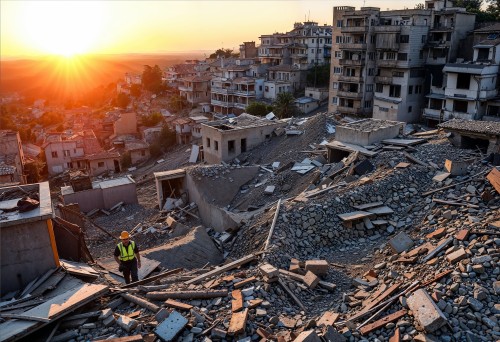
An intense offshore earthquake registering a magnitude of 7.8 struck the southern Philippines on Monday, leading to significant devastation. At least 35 people lost their lives, while over 200 sustained injuries. The seismic event also triggered a tsunami that impacted various coastal regions.
The epicenter of the quake was pinpointed off the coast of Mindanao, occurring at a depth of roughly 33 kilometers. The powerful tremor inflicted extensive damage, especially in General Santos City, where numerous buildings either collapsed or suffered severe structural harm. Search and rescue operations remain underway as teams strive to find individuals trapped in the rubble.
In Sarangani province, one of the most tragic incidents unfolded as a landslide, prompted by the earthquake, resulted in the deaths of 13 residents. Additional casualties were reported in nearby provinces due to the collapse of buildings and falling debris. Meanwhile, tsunami waves reaching heights of up to 1.4 meters struck parts of the southern coastline, damaging homes and coastal infrastructures. Smaller tsunami effects were also observed in Indonesia, Palau, and Japan, but authorities later rescinded the tsunami warnings after confirming the immediate danger had subsided.
The earthquake led to the temporary closure of General Santos International Airport, causing the cancellation of several domestic flights. Schools in the affected areas were shut down as emergency response teams evaluated the damage and coordinated relief efforts. President Ferdinand Marcos Jr. called for a swift government response, directing disaster management agencies to provide assistance to the impacted communities.
Officials have urged residents to exercise caution due to the potential for aftershocks and advised against returning to damaged structures until thorough safety inspections are completed. The Philippines’ vulnerability to earthquakes is well-known, given its position along the Pacific Ring of Fire, an area notorious for frequent seismic and volcanic activity.