

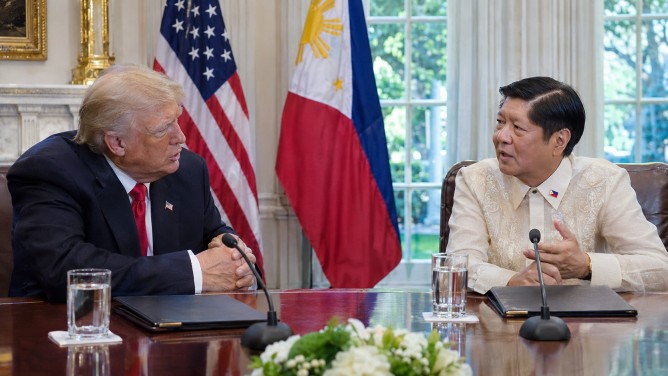
In a diplomatic move that underscores the United States’ strategic interests in Asia, President Donald Trump is set to meet with Philippine President Ferdinand Marcos Jr. in Manila this Wednesday. The meeting is anticipated to focus on bolstering US-Philippines security cooperation, particularly in light of escalating tensions between Manila and Beijing over territorial disputes in the South China Sea. This engagement comes as Marcos seeks stronger US security commitments to safeguard Philippine interests in the contested waters.
This meeting precedes President Trump’s planned high-stakes discussions in China with both Chinese President Xi Jinping and Russian President Vladimir Putin. These discussions aim to address pivotal issues such as trade relations, rare-earth supplies, and the imposition of advanced semiconductor technology restrictions. The diplomatic engagements are being closely monitored by US allies, given the potential implications on regional and global security dynamics.
Trump’s visit to the Philippines follows his participation in a meeting with leaders from the Quad, an alliance comprising the United States, India, Japan, and Australia. The Quad discussions revolved around regional security, critical minerals, maritime cooperation, and advancements in artificial intelligence, highlighting the US’s commitment to strengthening ties with its allies in the Indo-Pacific region.
Following his talks in Manila, President Trump will travel to Shenzhen for a significant dialogue with Xi. This meeting is expected to spotlight trade and technology issues, which have been points of contention in the US-China relationship. Additionally, a trilateral meeting involving Trump, Xi, and Putin is on the agenda, with discussions likely to cover the Ukraine conflict, Iran, and nuclear arms control.
The series of diplomatic engagements underscores the intricate balance of power and cooperation among major global players, with potential reverberations affecting regional stability and international relations. As the world watches, the outcomes of these meetings could shape the trajectory of US foreign policy in Asia and beyond.